The Best Way to Check if an Online Casino is Legit: The Ultimate Safety Checklist
Legit online casinos do not hide. Scam sites do. A shiny homepage, neon bonuses, or a slick logo mean nothing — the criminals put effort into the surface. We dig into the footer, the technical setup, the license number, the audit trail. That’s the forensic approach BestOrt is known for.
The uncomfortable truth is that the internet is full of copy-paste gambling sites pretending to be real operators. Some steal deposits. Some refuse withdrawals. Some use fake games with rigged code. If you land on the wrong page, the damage is instant and irreversible. That is why every player should learn how to identify safe online gambling sites before ever registering.
Our checklist is built around what scammers cannot fake: regulator links, audit certificates, encryption integrity, and long-term public reputation. These are the markers that separate the real brands from the noise. This is the foundation of proper scam casino verification: assume nothing is real until the evidence proves otherwise.
You are not here for guesses — you want a bulletproof method to confirm which casinos are legit, licensed, and safe to trust your money with. That begins with the first step: the license.
Table of Contents
A legit casino shows its authority in the footer — not the homepage. That tiny strip of text tells you if the operator is real, regulated, and accountable.
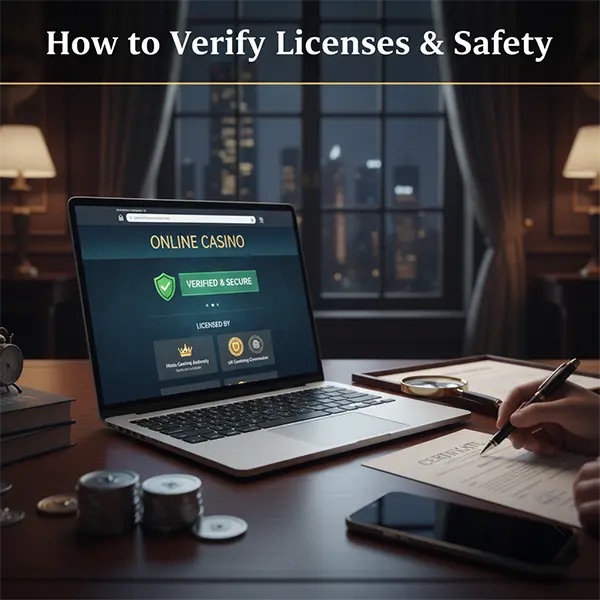
Scroll all the way down. You’re looking for a license reference — not a pretty badge, but a regulator stamp that actually leads somewhere. This is the foundation of how to check casino license data: if the operator is real, the footer should list the regulator and the license number clearly.
The big three regulators you should understand are the UKGC (United Kingdom), the MGA (Malta), and Curacao (global reach, lower barrier). If you need to check casino license MGA vs Curacao credibility, here is the blunt version: UKGC and MGA are strict, Curacao is lenient. Not bad — just different levels of oversight.
Now the validator test: click the regulator logo. A valid certificate always redirects to the regulator’s official website with the operator name, license number, and status. If the logo does nothing, if it is just an image, or if it opens a suspicious PDF hosted on the casino’s own domain — close the site. It is a fake.
Look at 888casino for example. Scroll to their footer, click the UKGC badge, and it redirects you to the official government registry — a perfect illustration of how a real operator displays its credentials.
3. Step 2: Technical Security & SSL
Even if the license is real, the site must protect your data. Security is not a decoration — it is math and encryption beneath the surface.
Start with the padlock icon in your browser’s address bar. That tiny lock indicates the casino uses SSL — Secure Socket Layer — which converts your credit card details into encrypted code. Without it, anyone intercepting the data can read it like plain text. This is the foundation of verifying ssl encryption casino sites at a glance.
Click the padlock. You should see a certificate chain, the issuing authority, and a validity range. If the certificate is expired, self-signed, or issued by a sketchy, unknown provider, do not play. A secure casino invests in proper encryption — the criminals don’t.
Legit operators also publish data protection statements: privacy policies, cookie policies, and GDPR compliance notes. You will usually find them in the footer. These are not marketing fluff — they are legal obligations, and trustworthy casinos follow them publicly.
If a site lacks both SSL and proper policy documentation, it is not a casino. It is a trap.
4. Step 3: Fairness & Audits (eCOGRA)
Legit casinos prove their fairness with third-party audits. Scams skip this part because they run rigged software behind the scenes.
Players often forget this: casinos do not develop the games. Providers do — studios like NetEnt, Play’n GO, Pragmatic Play. Those studios supply the RNG, not the casino. To prove the RNG is real, auditors like eCOGRA and iTech Labs run independent checks. That is the backbone of any eCOGRA audit verification guide.
If the casino is legitimate, it will display an RNG certification badge somewhere in the footer or inside the “Fair Play” or “Game Integrity” section. Click it — just like the license badge. A genuine auditor link leads to a public certificate page.
You can also find payout reports (RTP certificates). These are monthly or quarterly PDFs showing the average return percentages of different game categories. A transparent operator publishes them openly instead of hiding behind generic statements like “our games are fair”.
Casumo is a clean example. Their “Play Okay” area shows license numbers, audit badges, and links to responsible gaming groups — proof of a casino that has nothing to hide.
5. Step 4: Red Flags & The Blacklist
Some scam casinos are obvious. Others look polished until you scratch the surface. This step teaches you what the scammers always forget to hide.
Start with the basics. A fake casino often has no real address in the footer, support that feels like an automated chatbot loop, or Terms and Conditions (T&Cs) hidden behind tiny grey links. That alone can tell you more than the homepage ever will.
Next, scan for predatory terms. The most common scam tactic is placing withdrawal limits on progressive jackpots — something legitimate casinos never do. If you hit a €100,000 jackpot but the operator says you can only withdraw €500 per week, you are dealing with a predatory site.
Then there’s the “copycat scam”. Fraudsters clone the design of famous operators but switch the URL by a single character — adding a hyphen, changing a letter, or using an obscure domain extension. This is one of the clearest markers in any how to spot a fake online casino site method.
If a site triggers multiple red flags, assume it belongs to the blacklist of rogue online casinos 2025 even if you haven’t checked it manually. When in doubt, walk away.
6. Step 5: Social Proof (The “Reddit” Test)
When in doubt, listen to the crowd — not the casino’s own marketing. Real players leave digital footprints that scammers cannot clean up.
Use Google properly: type site:reddit.com [Casino Name] scam. This surfaces threads where real players discuss issues without filters or PR teams cleaning things up. It is the fastest way to check “is [Casino Name] legitimate reddit” without relying on sponsored reviews.
Sore losers complain about losing money — ignore those. You are looking for a different signal: disputes about frozen accounts, delayed withdrawals, KYC abuse, or a casino ignoring regulator instructions. Legit operators licensed by regulators like the UKGC or MGA have processes for all of this. Scams don’t.
If multiple independent users report the same issue, assume the risk is real. Social proof is not perfect, but it reveals patterns — and patterns don’t lie.
7. Conclusion
Legit casinos leave fingerprints everywhere — licenses, audits, SSL certificates, regulator links, payout reports, public discussions. Scams leave shadows. This guide organizes those signals into one clean, forensic process.
- Verify the license — and click the badge to confirm it redirects to the regulator.
- Check SSL encryption and inspect the certificate chain.
- Look for RNG and eCOGRA/iTech Labs audit links.
- Scan for red flags in the footer, support, and T&Cs.
- Run the Reddit test to confirm real-world user experience.
This structure matches Google’s How-To schema implicitly: a step-by-step checklist, each with a clear task the reader can perform. Perfect for triggering rich snippets — because it solves the exact search intent users have when they type “is this casino legit?”.
When all five steps point in the same direction, the conclusion is simple: trust it — or don’t.